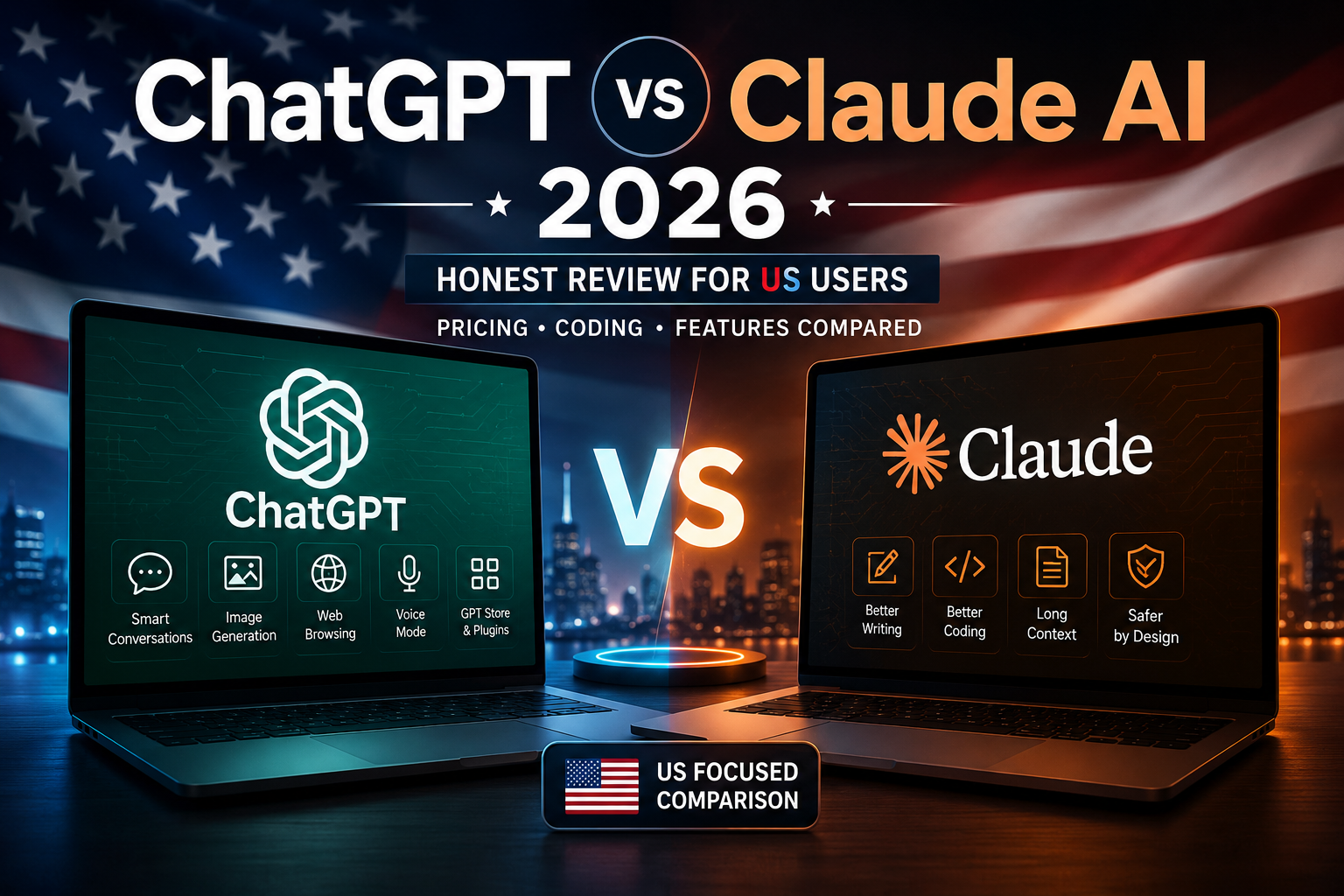
ChatGPT vs Claude AI 2026: Honest Review:
If you’ve typed “ChatGPT vs Claude AI” into Google, you’ve probably landed on a dozen articles that all say the same thing: “it depends on your use case,” followed by a vague list that doesn’t actually help you decide. I’m going to try to do better than that here, with a US-focused breakdown of pricing in dollars, real benchmark data, and the kind of day-to-day differences you’ll actually notice once you’re using either tool for work.
Both tools have changed a lot over the past year. OpenAI now ships GPT-5.5, and Anthropic’s flagship is Claude Opus 4.7. Both companies have added agentic coding tools, both have pushed context windows past the million-token mark, and both have quietly shifted their US pricing pages more than once in the last six months. So instead of repeating outdated benchmarks from 2024, this ChatGPT vs Claude AI comparison walks through what each tool is actually good at right now, what they cost in USD, and which one makes sense depending on what you’re trying to get done.
ChatGPT vs Claude AI: The Quick Verdict
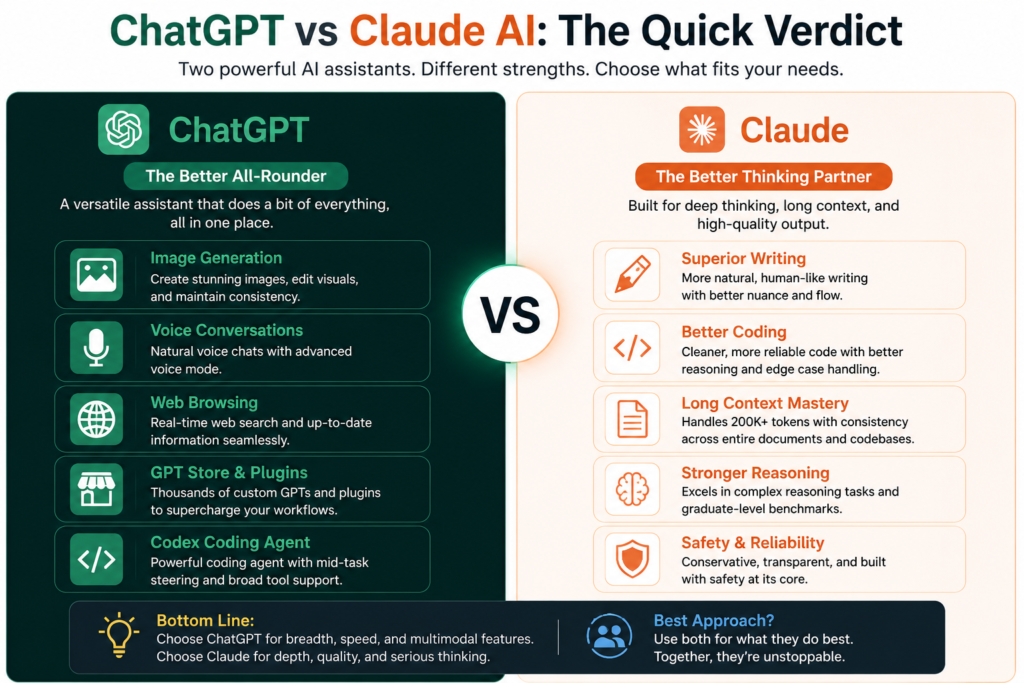
If you only have thirty seconds: ChatGPT is the better all-rounder. It generates images, talks to you out loud, browses the web smoothly, and has a massive library of custom GPTs and plugins. Claude is the better thinking partner. It writes more naturally, handles long documents and large codebases with less degradation, and most professional developers who’ve used both say it produces cleaner code.
Neither one is “the best AI” in some absolute sense. They’re built with different priorities, and which one wins depends entirely on what you’re using it for.
What Each Company Is Actually Trying to Build
OpenAI built ChatGPT to be a do-everything assistant. It writes, codes, generates images through its image tools, holds voice conversations, searches the web in real time, and runs custom mini-apps called GPTs that other users and companies have built. If you want one app that handles writing, research, coding, and creative work without switching tools, that’s the philosophy behind ChatGPT.
Anthropic built Claude around a different idea: get the reasoning and the writing right first, and be deliberately careful about safety along the way. Claude doesn’t try to do everything ChatGPT does — it still doesn’t generate images natively, for instance — but it’s consistently praised for the quality of its prose, its ability to hold a 200,000-token (or larger, on higher tiers) conversation without losing the thread, and for being the model professional coders increasingly reach for first.
Knowing that difference in philosophy actually explains most of the feature gaps you’ll see below.
ChatGPT vs Claude AI Pricing in 2026: Full US Cost Breakdown
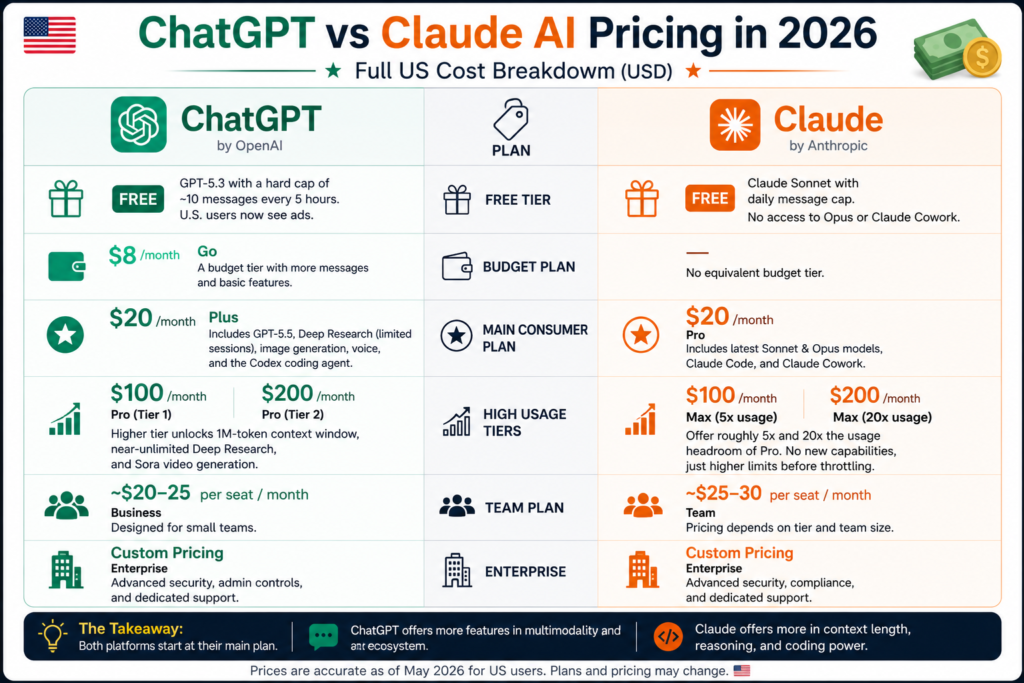
Both companies offer a free tier, but neither free tier is going to satisfy anyone using AI for real work. Here’s roughly where things stand for US customers, in USD:
ChatGPT
Free: GPT-5.3 with a hard cap of around 10 messages every 5 hours, and U.S. users now see ads at the bottom of responses. Go: $8/month — a budget tier with more messages and basic features, but no advanced reasoning model. Plus: $20/month — the main consumer plan. Includes GPT-5.5, Deep Research (limited sessions), image generation, voice, and the Codex coding agent. Pro: split into two tiers, $100/month and $200/month, with the higher tier unlocking a 1-million-token context window, near-unlimited Deep Research, and Sora video generation. Business: around $20–25 per seat/month, aimed at small teams. Enterprise: custom pricing.
Claude
Free: Claude Sonnet with a daily message cap, no access to Opus or Claude Cowork. Pro: $20/month ($17/month if billed annually) — includes the latest Sonnet and Opus models, Claude Code, and Claude Cowork. Max: two tiers at $100 and $200/month, offering roughly 5x and 20x the usage headroom of Pro. These don’t unlock new capabilities, just higher limits before you get throttled. Team: roughly $25–30 per seat/month depending on tier. Enterprise: custom pricing.
The headline price is basically identical: $20 a month gets you into the serious tier on either platform. The real difference is what that $20 includes. ChatGPT Plus packs in image generation, voice mode, and a bigger ecosystem. Claude Pro packs in a longer context window and an agentic coding tool that a lot of developers consider the more capable of the two. Neither is “cheaper” in a way that should drive your decision — pick based on which feature set you’ll actually use.
ChatGPT vs Claude AI for Coding: Which One Actually Wins?
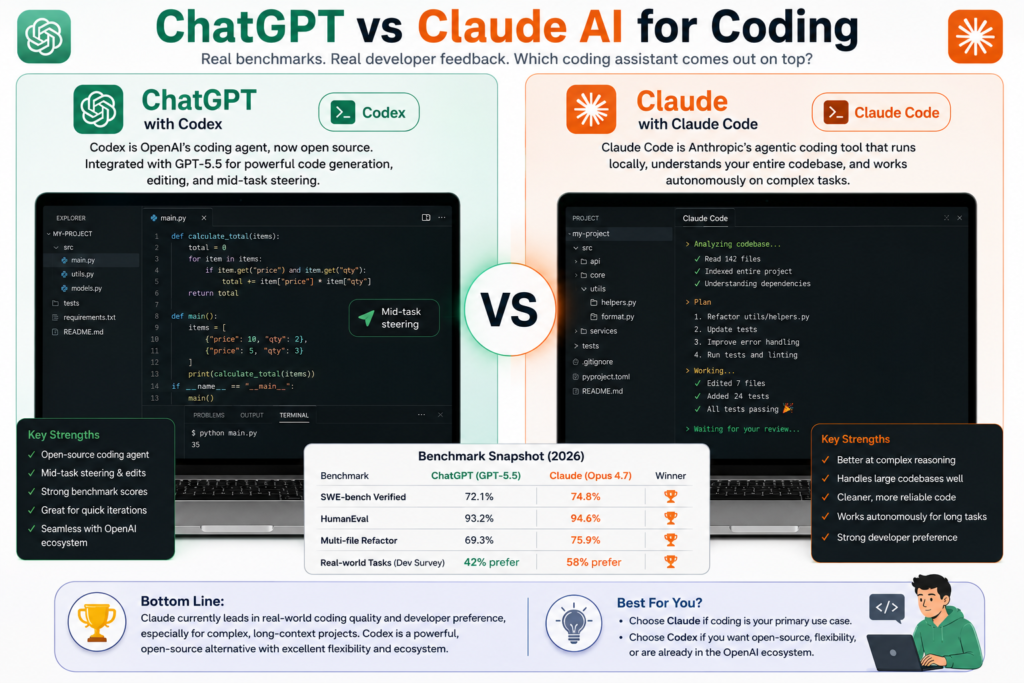
This is the category with the clearest separation between the two right now. On SWE-bench Verified, a widely-cited benchmark for real-world software engineering tasks, Claude’s flagship model edges out GPT-5.5 by a small but consistent margin, and several independent surveys report a majority of working developers preferring Claude when asked directly.
What that looks like in practice: Claude tends to think through edge cases before writing code rather than producing a fast first draft, its variable naming and code structure get described as cleaner and more idiomatic, and it’s noticeably more willing to say “I’m not sure” rather than confidently hand you something broken. Claude Code, Anthropic’s terminal-based coding agent, runs locally on your machine, reads your whole codebase, edits files across multiple directories, and can work autonomously for long stretches while checking in for your input. It’s become popular enough that one of the most widely used AI coding editors uses Claude as its default model.
ChatGPT’s answer is Codex, which OpenAI made open source — a genuine advantage if you want to inspect or extend the tool yourself. Codex also supports mid-task steering, meaning you can redirect it while it’s working instead of restarting from scratch, and GPT-5.5 is no slouch on coding benchmarks either. For developers who live inside the broader OpenAI ecosystem already, or who want an open-source agent, Codex is a perfectly solid choice.
Bottom line: if writing, reviewing, or shipping code is your main use case, most current evidence points toward Claude. If you want an open-source coding agent or you’re already deep in OpenAI’s tooling, Codex closes most of the gap.
ChatGPT vs Claude AI for Writing and Content Creation
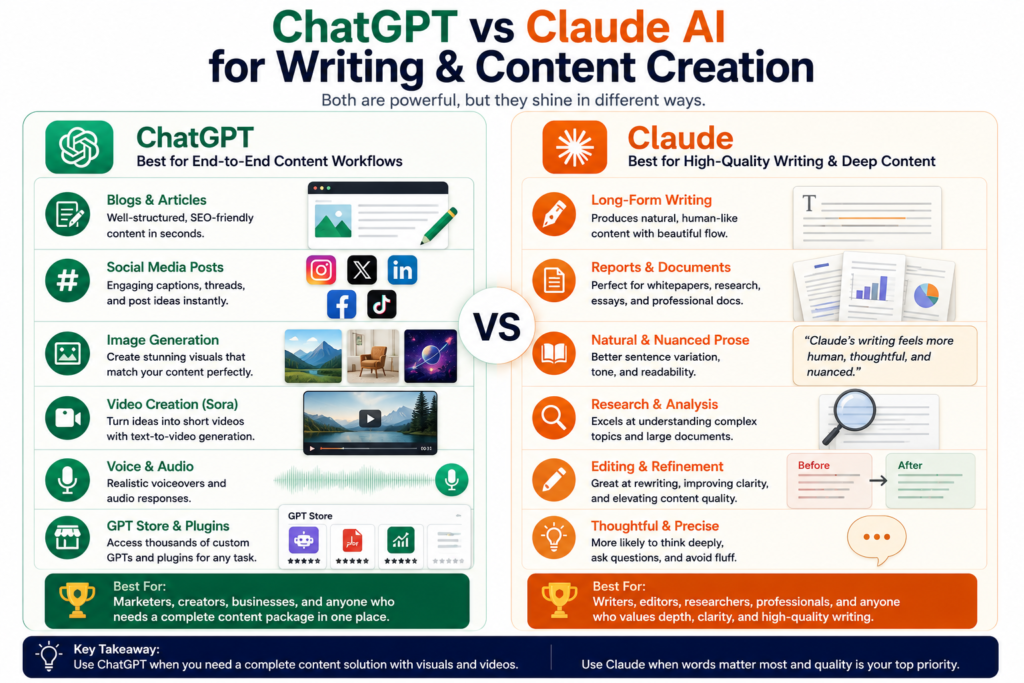
This is more subjective, but the pattern shows up again and again in independent reviews: people consistently describe Claude’s prose as reading more naturally, with better sentence-length variation and fewer of the stock phrases that make AI writing easy to spot. ChatGPT’s writing is polished and competent, and it’s genuinely flexible across tones and formats, but reviewers repeatedly flag a tendency toward predictable structure and the kind of cliché-heavy phrasing that’s become a giveaway for AI-generated content.
That said, ChatGPT’s breadth gives it an edge for certain content workflows. If you’re producing a blog post that needs a hero image, a social caption, and maybe a short explainer video, ChatGPT can do the whole job in one tab through its image and video tools. Claude will write you the better paragraph, but you’ll need a separate tool for the visuals.
If your priority is the quality of the actual sentences — long-form articles, professional reports, nuanced editing — lean Claude. If your priority is producing a complete content package without leaving the app, lean ChatGPT.
Claude vs ChatGPT: Context Windows and Long Document Handling
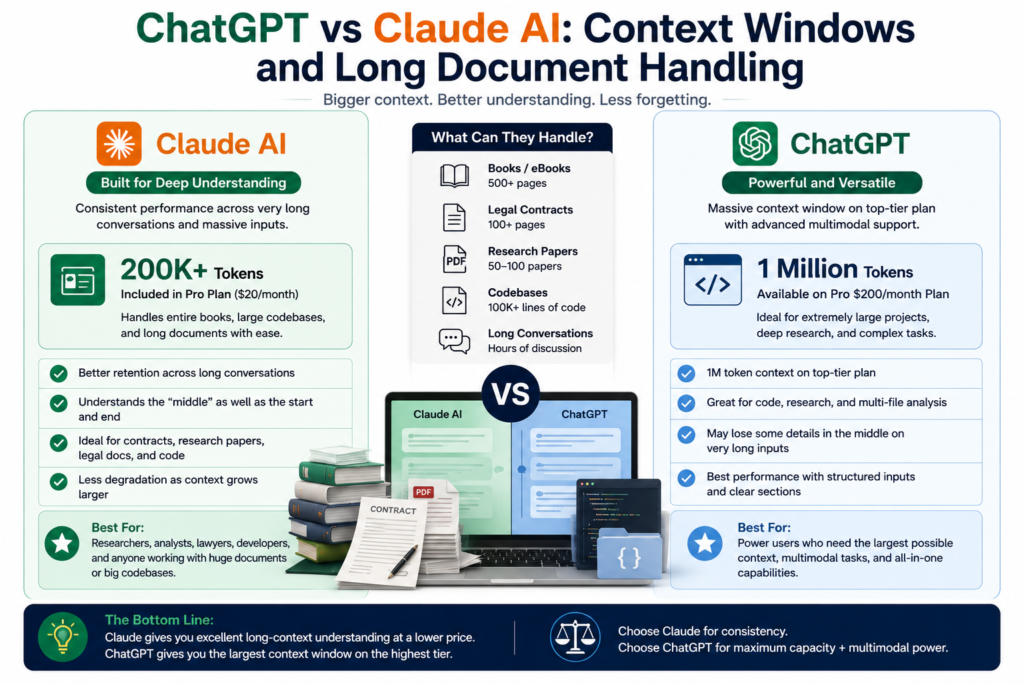
Context window size used to be a clear Claude advantage; it’s narrowed somewhat now that GPT-5.5 also ships with a 1-million-token option, but the practical experience still differs. Reviewers who’ve stress-tested both report that Claude’s context holds up more evenly across a long conversation, with less of the “forgetting the middle of the document” problem that some users still notice with GPT-5.5 on extremely long inputs.
If your work involves dropping in an entire contract, a multi-hundred-page PDF, a legal deposition, or a sprawling codebase and asking detailed questions about all of it, Claude’s consistency across that full range tends to be the more reliable experience. ChatGPT can technically match the token count on its top tier, but you’re paying $200/month to get there, versus Claude’s 200K-token window included at the $20 tier.
ChatGPT vs Claude AI: Multimodal Features Compared
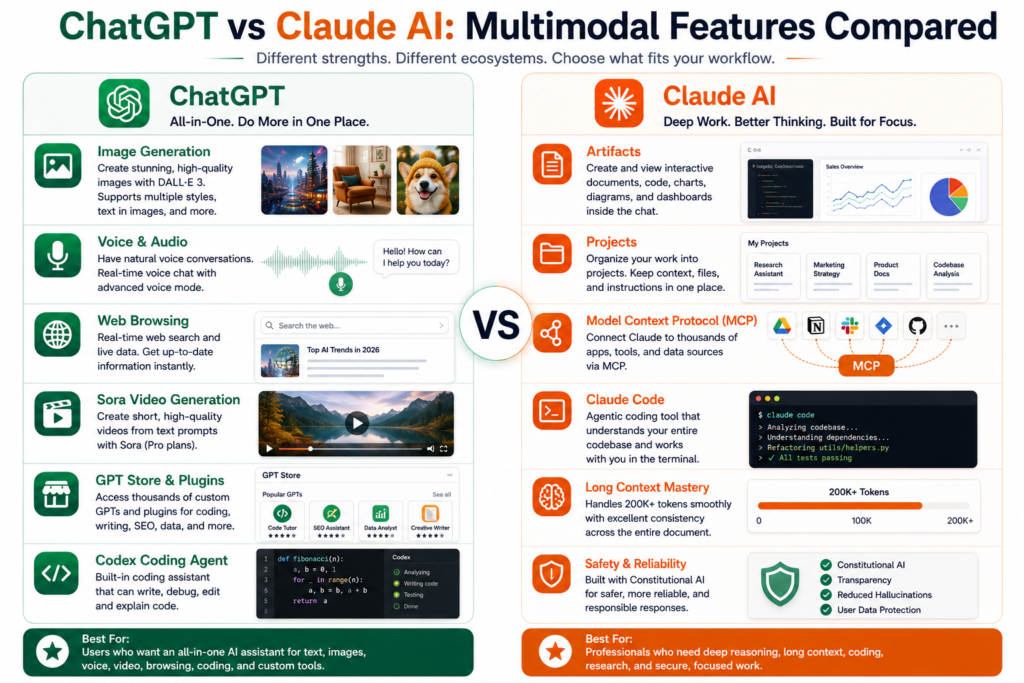
There’s no real debate here — if you want native image generation, ChatGPT wins outright. Its image tools handle multi-image consistency, multilingual text rendering, and a “thinking mode” that reasons through complex visual requests before generating. Claude has no equivalent; you’d need to bolt on a separate image generator.
ChatGPT also has the more mature voice mode, built-in web browsing that feels more seamlessly integrated into a normal conversation, and Sora for video generation on its top-tier plan. Add in the GPT Store — thousands of community-built mini-apps for everything from SQL generation to specialized tutoring — and you get a genuinely larger toolkit if your day involves jumping between very different kinds of tasks.
Claude’s answer is the Model Context Protocol (MCP), which connects it to thousands of external apps and services, plus Artifacts for rendering live documents, code, and visualizations inline, and Projects for persistent, organized workspaces. It’s a real ecosystem, just a different shape — closer to “plug Claude into your existing tools” than “do everything inside one app.”
Reasoning and Safety: Claude vs ChatGPT
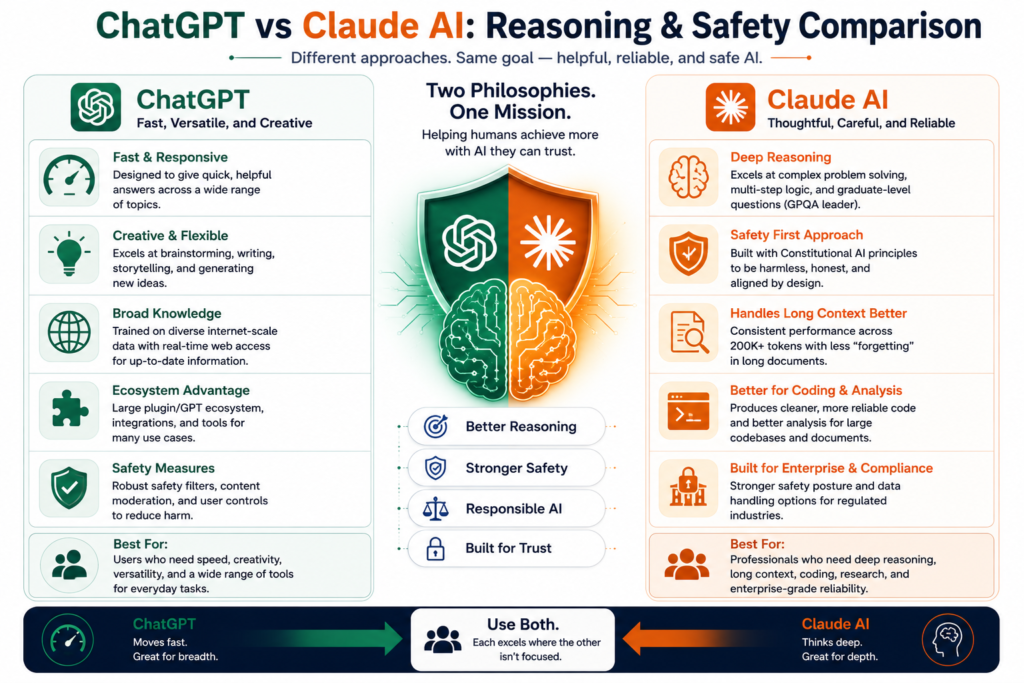
On GPQA Diamond, a graduate-level science and reasoning benchmark, Claude’s flagship currently holds the widest lead of any major benchmark comparison between the two companies. Anthropic has also built its safety approach — something it calls Constitutional AI — directly into training rather than relying purely on after-the-fact filtering, which matters if you’re deploying AI in a regulated field like US healthcare, finance, or legal work and need to document your risk controls for compliance.
ChatGPT isn’t unsafe by any reasonable measure, and OpenAI has its own extensive safety work, but the two companies have made visibly different trade-offs: Claude tends to be more conservative and more likely to flag uncertainty, while ChatGPT tends to move faster and be more willing to commit to an answer. Depending on your work, either of those can be the right behavior. For US businesses with data residency requirements, both vendors now offer enterprise plans with US-based data handling options, so check the specific contract terms rather than assuming either one by default.
ChatGPT or Claude AI: Which One Should US Users Pick?
Here’s how it tends to shake out by user type:
Students and casual users: ChatGPT’s free tier and $8 Go plan are more forgiving for light, varied use — homework help one day, a meme image the next. If you mostly want one flexible tool, start there.
Writers, editors, and content teams: Claude’s writing quality and document handling make it the stronger default, especially for long-form or research-heavy work. Keep ChatGPT around if you regularly need accompanying images or video.
Developers: Claude, particularly with Claude Code, currently has the edge for serious coding work — cleaner output, better handling of large codebases, and strong developer sentiment behind it. If you want an open-source agent or you’re embedded in OpenAI’s developer tools already, Codex is a legitimate alternative.
Researchers and analysts working with long documents: Claude’s context reliability across very long inputs is the more dependable choice, especially at the $20 price point rather than ChatGPT’s $200 tier.
Marketers and all-in-one creators: ChatGPT’s combination of text, image, voice, and video in a single subscription is hard to beat if your workflow spans multiple media types.
Businesses evaluating either for teams: Pricing lands in a similar range at the entry level. The decision usually comes down to whether your team needs ChatGPT’s broader integrations and Microsoft ecosystem ties, or Claude’s stronger coding and document-analysis tools paired with its more conservative safety posture.
Final Verdict: ChatGPT vs Claude AI in 2026
Anyone telling you one of these is definitively “the best AI” in 2026 either hasn’t tested both seriously or has a reason to push you toward one. The gap between frontier models has narrowed enormously since 2023 — what used to be obvious capability cliffs are now small percentage-point differences on specific benchmarks. The two tools have converged on quality and diverged on personality and ecosystem instead.
If you can justify $40 a month, running both and using each for what it does best is genuinely the most effective approach a lot of US professionals have landed on: ChatGPT for breadth, speed, and multimodal tasks; Claude for depth, writing quality, and serious coding or document work. If you can only pick one, match it to whichever category above sounds most like your actual day, not the one with the flashier headline. Either way, this ChatGPT vs Claude AI comparison should give you enough to make a confident, US-dollar-informed decision rather than guessing.
ChatGPT vs Claude AI: Frequently Asked Questions(FAQ)
Is Claude better than ChatGPT for coding?
Current benchmarks and developer surveys generally favor Claude, especially for complex debugging, multi-file refactors, and long-codebase work. ChatGPT’s Codex is still a strong, genuinely usable alternative, and it has the advantage of being open source.
Is ChatGPT free to use?
Yes, but the free tier is limited to a small number of messages every few hours on an older model, and U.S. users now see ads on it. For daily, serious use, most people end up on a paid plan.
Does Claude generate images?
No. Claude doesn’t have a native image generator, so if your workflow depends on creating visuals inside the same chat, ChatGPT is the more practical option.
Which one has a bigger context window?
Both now offer roughly 1 million tokens on their top-tier plans. The difference is that Claude includes a 200,000-token window at its standard $20/month tier, while ChatGPT’s largest window is reserved for its $200/month plan.
Can I switch between the two without losing work?
Mostly, yes. Both let you export or copy conversations, and neither locks your files into a proprietary format you can’t get back out. Just be aware that custom instructions, saved memory, and any custom GPTs or Projects you’ve built are tool-specific and won’t transfer over.
Which one should a small business pick?
It depends more on what the team actually does day to day than on price, since both land in a similar range. Teams doing a lot of content production, research synthesis, or coding tend to gravitate toward Claude; teams that need broader integrations, a wider plugin ecosystem, or tighter Microsoft/Google tooling tend to lean ChatGPT.
Read Also:-
ChatGPT Review 2026
Claude AI Review 2026

Hey, I’m Manish
I’ve tested 100+ AI tools since 2023 and reviewed them honestly on ZentroAI.
My mission: Help you discover the best AI tools without the hype.
Whether you need ChatGPT alternatives, coding assistants, or image generators .
you’ll find detailed, hands-on reviews here.