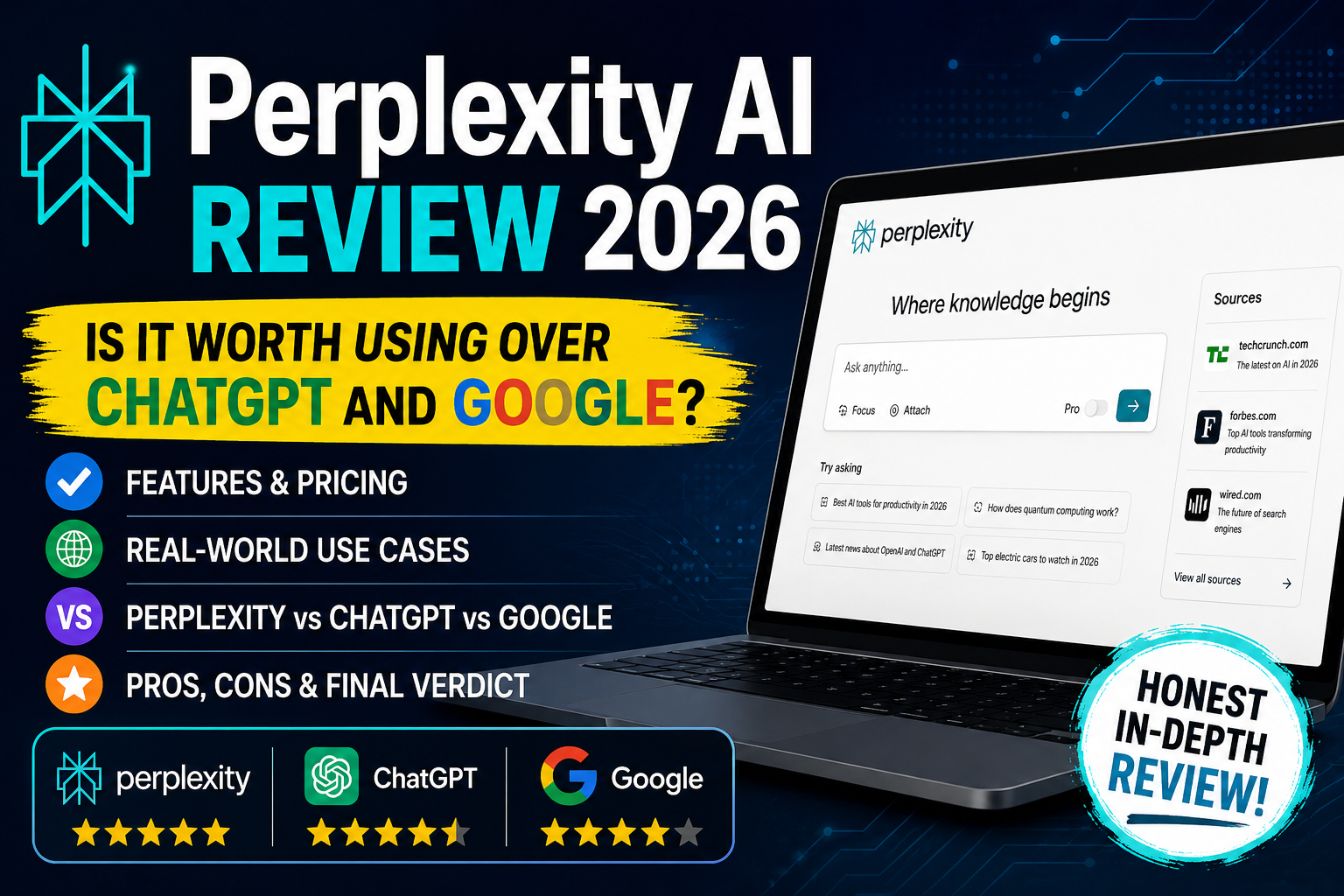
Perplexity AI Review 2026:
If you’ve spent any time online in the past couple of years, you’ve probably heard someone rave about Perplexity AI. It’s often described as “the answer engine that’s killing Google search,” which is a bold claim, but after spending weeks using it daily for research, writing, and everyday questions, I wanted to put together an honest, no-fluff review of what this tool actually does well, where it falls short, and whether it deserves a spot in your daily browser tabs.
This review covers everything from pricing and features to real-world use cases, so whether you’re a student, a content creator, a developer, or just someone tired of scrolling through ten blue links to find one decent answer, you’ll know exactly what to expect.
What Is Perplexity AI, Exactly?
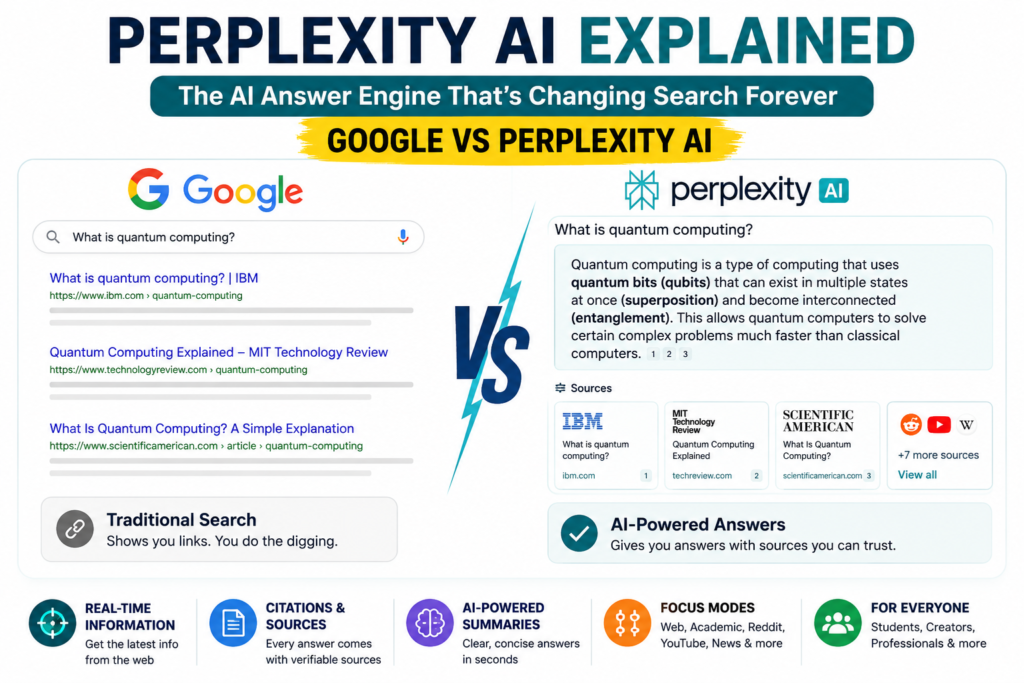
Perplexity AI is an AI-powered search and answer engine. Unlike a traditional search engine like Google or Bing, which hands you a list of links and leaves you to do the digging, Perplexity reads the web for you and gives you a direct, conversational answer, complete with citations linking back to the original sources.
Think of it as a hybrid between a chatbot and a search engine. You type a question, and instead of getting ten links to sift through, you get a written summary with footnotes showing exactly where each fact came from. That citation system is really the heart of what makes Perplexity different from a regular AI chatbot like ChatGPT, and it’s also what makes it feel more trustworthy for research-heavy tasks.
The company behind it was founded by a small team of former Google, Meta, and OpenAI engineers, and it has grown rapidly thanks to backing from major investors. That funding has allowed Perplexity to keep improving its models and rolling out new features at a pace that’s hard for smaller competitors to match.
First Impressions: The Interface
The first thing you notice when you open Perplexity is how clean the interface is. There’s a simple search bar in the middle of the screen, almost like Google’s homepage but with a softer, more modern design. No ads, no clutter, no fifteen widgets fighting for your attention.
Once you type a query and hit enter, the page transforms into a results view with three key sections: the main answer at the top, a row of source thumbnails on the side, and suggested follow-up questions at the bottom. This layout makes it incredibly easy to verify information without leaving the page, which is a small thing but makes a huge difference when you’re doing actual research instead of just casually asking questions.
How Perplexity AI Actually Works
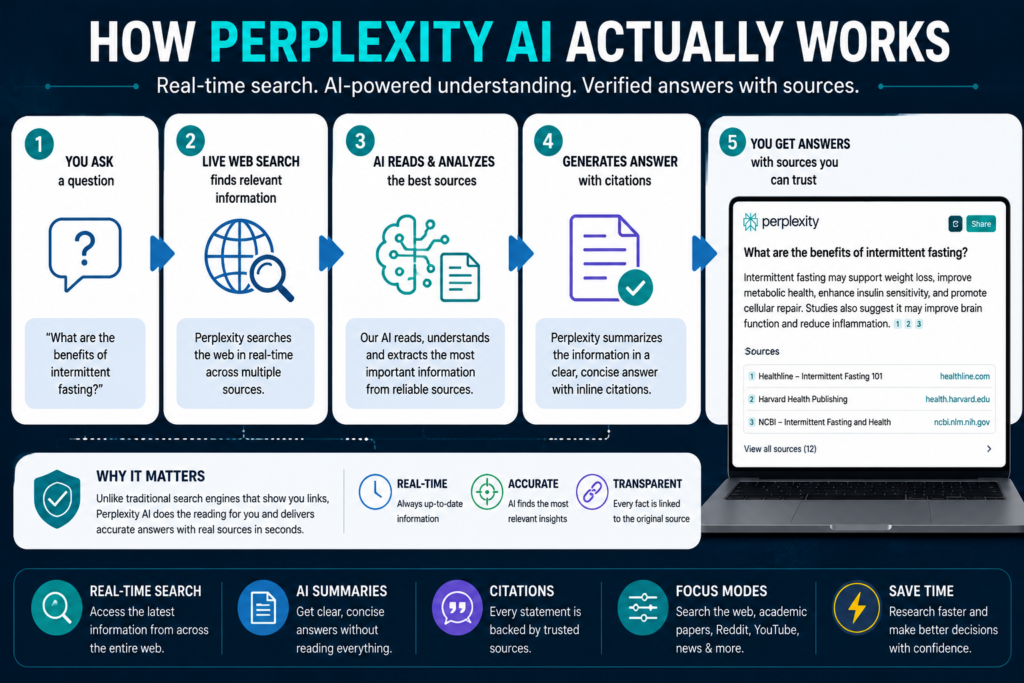
Perplexity doesn’t rely on a single AI model. Instead, it combines its own in-house models with access to other leading models depending on the plan you’re on, then pairs that with real-time web search. When you ask a question, the system performs a live search, pulls relevant pages, reads through them, and then generates a summarized response with inline citations.
This matters because it solves one of the biggest complaints people have about standard chatbots: outdated or made-up information. Because Perplexity is constantly pulling fresh data from the internet, it can answer questions about current events, recent product launches, or anything time-sensitive far more reliably than a chatbot that was trained on a fixed dataset months or years ago.
That said, it’s not flawless. Like any AI tool, it can occasionally misread a source or summarize something slightly out of context. The good news is that because every claim is linked to its source, you can quickly double-check anything that seems off, which is something you simply can’t do with most AI chatbots.
Key Features Worth Knowing About
Focus Modes
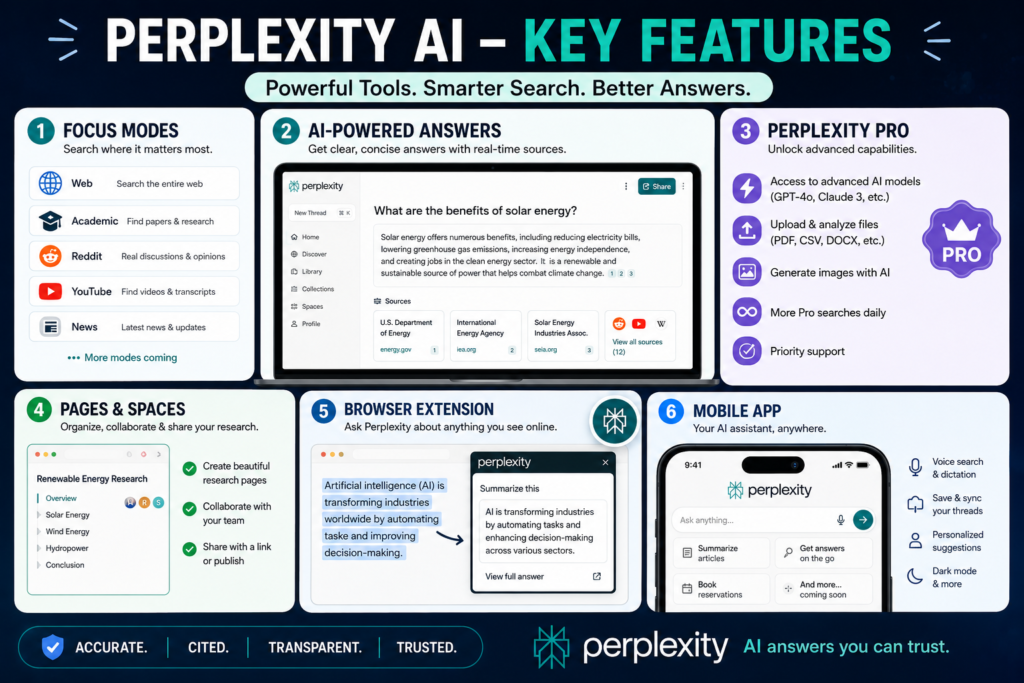
One of the most useful features is the ability to switch between different “focus modes” depending on what kind of answer you need. You can search the entire web, restrict results to academic papers, search only Reddit discussions, look specifically at YouTube videos, or focus on recent news. This flexibility makes Perplexity genuinely useful across very different types of research, whether you’re writing a school paper or trying to find real opinions from actual people on a forum.
Perplexity Pro
The paid tier unlocks access to more advanced AI models, a higher number of daily searches with premium features, file upload and analysis, and an image generation tool. For anyone doing serious research, content writing, or coding work, the Pro plan tends to pay for itself fairly quickly in time saved.
Perplexity Pages and Spaces
These features let you turn your research sessions into shareable, organized documents or collaborative workspaces. If you’re working on a group project, building a knowledge base, or just want to keep your research tidy instead of scattered across browser tabs, this is a genuinely handy addition.
Perplexity Assistant and Mobile App
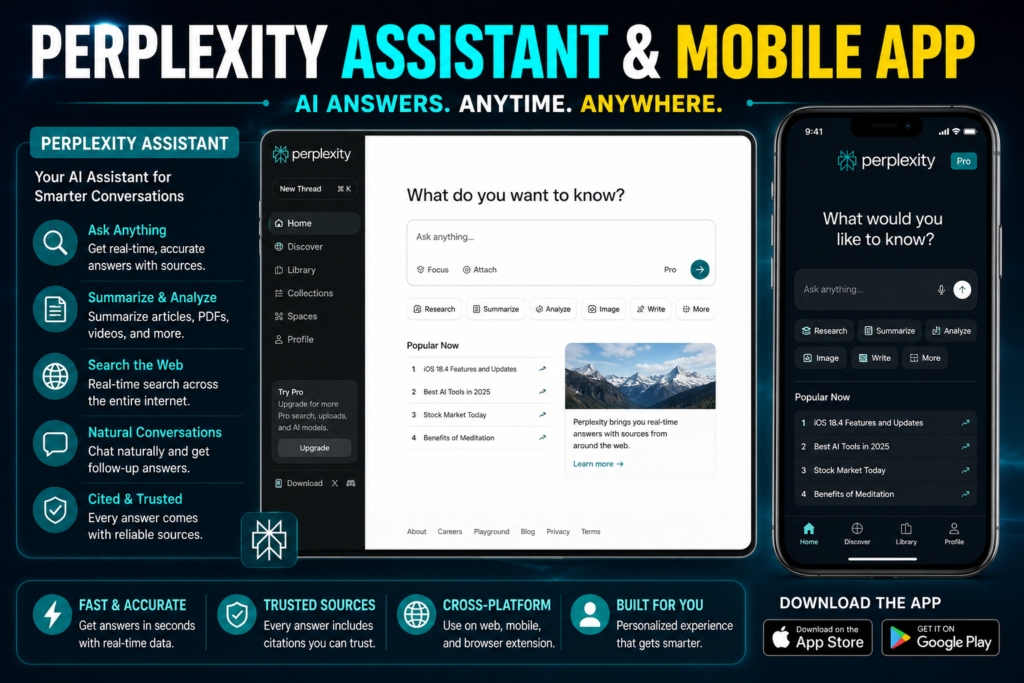
The mobile experience has matured a lot. The app can act almost like a personal assistant, capable of handling tasks like booking reservations, summarizing your day, or pulling information across multiple apps on your phone. It’s not perfect yet, but it points toward where the product is heading.
Browser Extension
There’s also a browser extension that lets you highlight text on any webpage and ask Perplexity to explain, summarize, or fact-check it instantly. For students and researchers, this single feature alone can save a significant amount of time.
Perplexity vs ChatGPT vs Google: How Does It Compare?
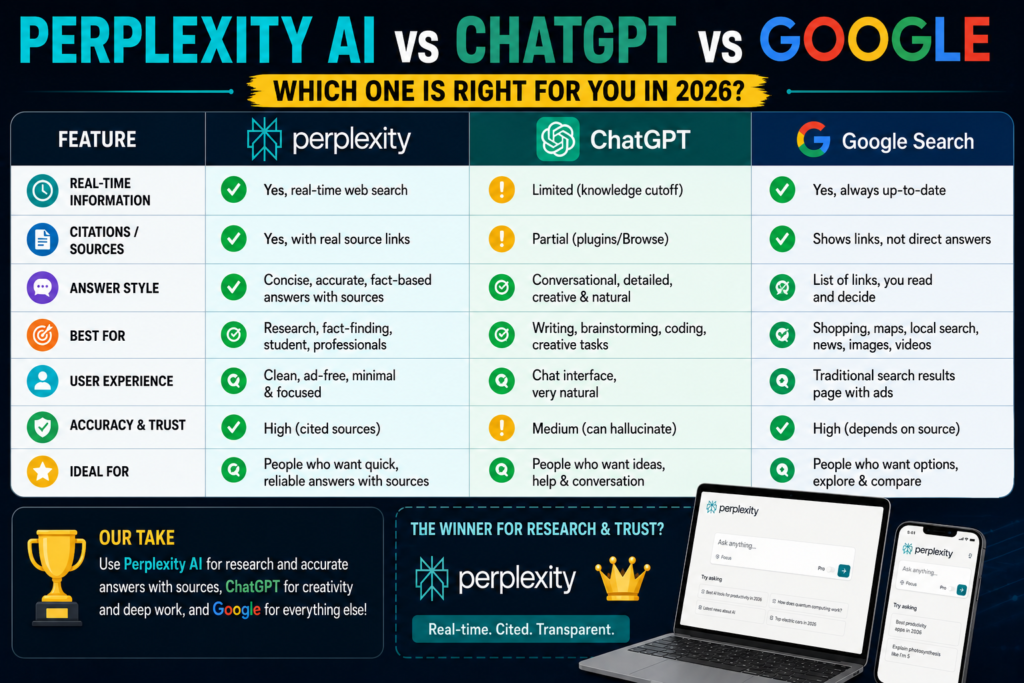
This is probably the question most people actually care about, so let’s break it down honestly.
Compared to Google, Perplexity wins on convenience. You get a direct answer instead of having to click through multiple sites, which is especially valuable for factual or research-based questions. However, Google still wins for local searches, shopping, maps, and the sheer breadth of its index, which has been built over two decades.
Compared to ChatGPT, Perplexity’s biggest advantage is real-time information with verifiable sources. ChatGPT is fantastic for creative writing, coding help, and open-ended conversation, but it doesn’t naturally cite sources the way Perplexity does by default. On the other hand, ChatGPT often feels more natural for long, flowing conversations, brainstorming, and creative tasks, while Perplexity feels more purpose-built for “I need an accurate answer right now.”
In practice, a lot of power users end up using both: ChatGPT for creative and conversational work, Perplexity for anything that needs sourced, current, factual answers.
Real-World Use Cases
After using Perplexity consistently, here’s where it genuinely shines.
For students, it’s excellent for literature reviews, quick fact-checking, and getting a starting point on unfamiliar topics, especially with the academic focus mode that filters results to scholarly sources.
For content creators and bloggers, it speeds up the research phase dramatically. Instead of opening fifteen tabs to gather background information for an article, you can get a solid foundation in a few minutes, then dig deeper into the cited sources for the details that matter.
For professionals doing market research, competitive analysis, or staying on top of industry news, the combination of real-time search and source citations makes it far more reliable than relying on a chatbot’s internal knowledge alone.
For everyday users, it’s simply a faster way to get answers to questions that would otherwise require sorting through ads, SEO spam, and clickbait headlines on a traditional search engine results page.
Where Perplexity AI Falls Short
No tool is perfect, and it’s worth being upfront about the limitations.
The free plan has usage limits on the more advanced models, so heavy users will likely feel the need to upgrade fairly quickly. The quality of answers can also vary depending on how niche or obscure your question is; for very specialized or technical topics, it sometimes pulls from lower-quality sources if better ones aren’t readily available.
It’s also still not a full replacement for traditional search in every scenario. Tasks like comparison shopping, finding local businesses, or browsing through visual content are still handled better by dedicated platforms. And like every AI tool currently on the market, it can occasionally produce a confidently worded answer that turns out to be slightly inaccurate, so a habit of checking the linked sources is still a smart practice.
Pricing Breakdown
Perplexity offers a generous free tier that’s genuinely usable for casual or moderate needs, which is part of why it’s gained such a large user base so quickly. The Pro subscription is priced competitively against other premium AI tools on the market and adds meaningfully more value for anyone using it for work, study, or content creation on a regular basis. There’s also an Enterprise option aimed at teams and businesses that need more advanced collaboration, security, and admin controls.
For most individual users, starting with the free version and upgrading only if you hit the usage limits is the most sensible approach.
Is Perplexity AI Trustworthy?
Trust is probably the most important factor for any AI search tool, and this is genuinely one of Perplexity’s strongest areas. Because every factual claim links back to a real source, you’re never just taking the AI’s word for it. This transparency builds a level of trust that’s hard to find elsewhere in the AI space, where many tools still operate as a complete black box.
That said, “trustworthy” doesn’t mean “infallible.” It’s still wise to treat AI-generated summaries as a starting point rather than a final word, particularly for anything medical, legal, or financial, where the stakes of being wrong are higher.
Frequently Asked Questions
Is Perplexity AI free to use?
Yes. Perplexity has a free tier that gives you a solid number of searches and access to its core AI model. You only need to pay if you want unlimited access to premium models, file uploads, and image generation through the Pro plan.
Is Perplexity AI better than Google?
It depends on what you’re searching for. For direct, factual questions, Perplexity is often faster and more convenient because it gives you a summarized answer with sources instead of a list of links. For local searches, shopping, or maps, Google is still the better choice.
Is Perplexity AI better than ChatGPT?
They serve different purposes. Perplexity is built around real-time web search and source citations, making it stronger for research and fact-checking. ChatGPT tends to feel more natural for creative writing, brainstorming, and longer conversations. Many users rely on both, depending on the task.
Does Perplexity AI cite its sources?
Yes, this is one of its defining features. Every answer includes inline citations linking back to the original web pages, so you can verify the information yourself instead of just trusting the AI’s summary.
Can Perplexity AI make mistakes?
Like any AI tool, it can occasionally misinterpret a source or generate an answer that’s slightly off, especially for very niche or technical topics. Because sources are always linked, it’s easy to double-check anything that seems questionable.
Is Perplexity AI good for students?
Yes. The academic focus mode filters results to scholarly sources, which makes it useful for literature reviews, research papers, and quickly understanding unfamiliar topics before diving deeper.
Does Perplexity AI have a mobile app?
Yes, it’s available on both iOS and Android, and the app includes assistant-style features that go beyond simple search, such as summarizing information and helping with everyday tasks.
How much does Perplexity Pro cost?
Pricing is competitive with other premium AI subscriptions on the market. Since pricing can change over time, it’s best to check Perplexity’s official website for the most current rate before subscribing.
Is Perplexity AI safe and trustworthy?
Its citation-based approach makes it more transparent than many AI tools, since you can trace every claim back to its source. That said, it’s still wise to treat AI-generated answers as a starting point, particularly for medical, legal, or financial questions, rather than a final authority.
Can I use Perplexity AI for free without an account?
You can use basic search without signing up, but creating a free account unlocks a higher usage limit, saved search history, and access to features like focus modes and Spaces.
Final Verdict
So, is Perplexity AI worth using? For most people doing any kind of research, writing, or fact-finding online, the answer is a clear yes. It strikes a genuinely useful balance between the speed of a chatbot and the credibility of a search engine, and the citation system alone sets it apart from most AI tools currently available.
It’s not going to fully replace Google for every type of search, and it’s not going to replace ChatGPT for purely creative work, but as a dedicated research and answer engine, it has carved out a clear and valuable niche. If you haven’t tried it yet, the free version is more than enough to get a feel for whether it fits into your daily workflow, and there’s a good chance it will earn a permanent spot next to your other go-to tools.
Whether you’re a student trying to finish a research paper faster, a professional who needs quick, sourced answers, or just someone who’s tired of ad-cluttered search results, Perplexity AI is one of the more genuinely useful AI products to come out in the last few years, and it’s worth giving a real shot.
Read Also…..
Claude AI Review 2026: Is It Really Worth Using? My Honest Take

Hey, I’m Manish
I’ve tested 100+ AI tools since 2023 and reviewed them honestly on ZentroAI.
My mission: Help you discover the best AI tools without the hype.
Whether you need ChatGPT alternatives, coding assistants, or image generators .
you’ll find detailed, hands-on reviews here.